PR agency vs in-house PR is more than a comparison of job titles. It is a choice about the pace of your days, the people you learn from, how close you get to business decisions, and the kind of pressure you are willing to carry home.
The short answer: A PR agency may be the stronger fit if you want exposure to multiple clients, varied industries, and fast-moving campaigns. In-house PR may suit you better if you want to understand one organization deeply, influence its long-term reputation, and work closely with its leadership. Neither path guarantees better pay, healthier hours, or greater satisfaction. The specific employer matters at least as much as the model.
The Career Decision That Looks Simple Until It Is Yours
Imagine this: It is 7:42 p.m., and Maya is still at her desk. She has just sent the final version of a client announcement, checked tomorrow’s journalist outreach list, and replied to a request labeled “urgent” that probably could have waited. Her phone lights up with a message from a former colleague.
“We have an opening on our internal communications team. Thought of you.”
Maya has spent three years in an agency. She has learned to write under pressure, juggle competing priorities, and recover from pitches that never receive a reply. She is proud of what she has built, but she is tired. An in-house job sounds like an escape: one brand, fewer clients, fewer late-night surprises.
Then she hesitates. What if she misses the variety? What if a slower organization feels limiting? What if the new role comes with different pressures nobody warned her about?
Maya is a fictional illustration, not a sourced account. But the trade-offs in her decision reflect the career questions and professional experiences described in the supplied reading.
If you are asking whether to work at a PR agency or move in-house, the most useful question is not “Which is better?” It is “Which environment helps me do my best work at this stage of my life?”
What Is the Difference Between PR Agency and In-House PR?
Working at a PR agency
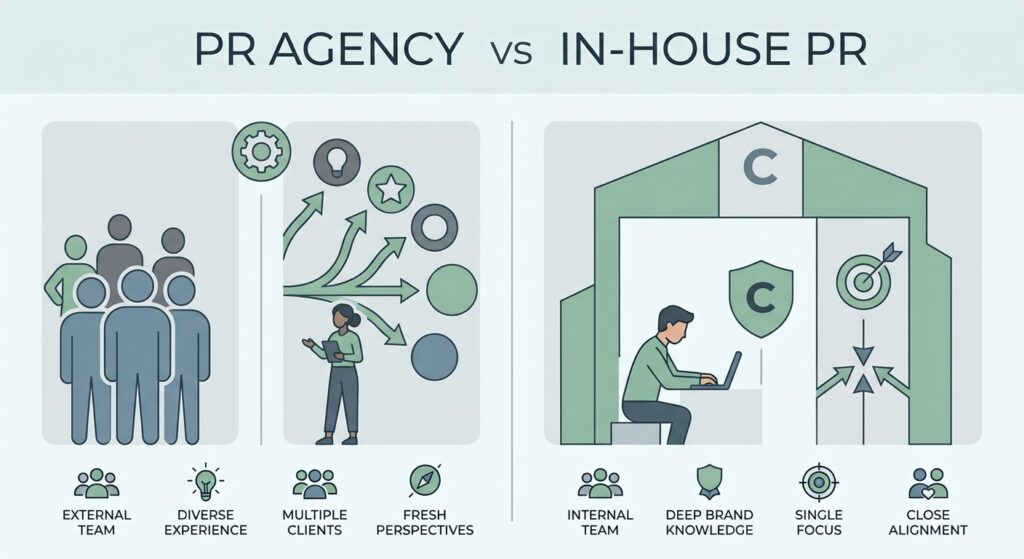
A public relations agency is an external firm hired to support client communications. Depending on the firm, agency professionals may work on media relations, press releases, thought leadership, reputation management, crisis communications, executive visibility, research, and reporting. An agency employee might support one large account or several clients at once.
The central feature of agency life is its client-service model. You must understand an organization’s story while also meeting deadlines, managing expectations, and communicating the value of your team’s work.
Working in-house in PR
In-house PR means working directly for the organization whose reputation you help manage. The team may be a single communications professional or a department spanning external communications, internal communications, public affairs, crisis response, and executive communications.
The central advantage is proximity: you can develop a deeper understanding of products, leadership, culture, strategy, and the decisions behind the news. But proximity can also bring organizational politics and unclear expectations.
PR Agency vs In-House PR: Side-by-Side Comparison
| Factor | PR agency | In-house PR |
|---|---|---|
| Primary focus | Serve client accounts and campaigns | Build one organization’s reputation |
| Daily variety | Often high across clients and sectors | Often deep across one company’s teams |
| Learning | Broad exposure and agency peer mentorship | Deep business and organizational expertise |
| Work pace | Multiple client deadlines and changing priorities | Internal approvals, leadership needs, and company cycles |
| Career growth | Account leadership, specialist and business-development paths | Communications management and executive advisory paths |
| Media relations | Contacts may span several sectors | Relationships may deepen in one industry |
| Work-life balance | Highly dependent on clients and agency culture | Highly dependent on company culture and events |
| Pressure | Client expectations, account economics, sometimes time tracking | Internal politics, stakeholder alignment, demonstrating value |
| Compensation | Depends on level, firm, market and incentives | Depends on level, employer, market and benefits |
Typical differences, not universal rules. The actual job description and manager are more predictive than the label alone.
Five Reasons You Might Love Working at a PR Agency
1. You learn through variety
One week you are learning a cybersecurity product. The next, you are preparing a healthcare executive for an interview or launching a consumer campaign. That variety teaches you to research quickly, ask sharper questions, and turn unfamiliar subjects into understandable stories.
2. You work alongside people who speak your professional language
In many agencies, other PR practitioners understand the emotional difference between a positive journalist reply and a generic inbox rejection. That peer environment can be valuable when you are learning the craft.
3. You build repeatable campaign skills
Account planning, writing, pitching, client management, reporting, and deadline coordination become part of your working rhythm. These skills can transfer into an internal communications role later.
4. You discover what kind of PR you actually enjoy
You may arrive thinking you love media relations and discover that you prefer issues management, internal storytelling, or executive communications. Multiple accounts can help you test those interests before specializing.
5. You can see the immediate results of your work
A launch goes live. A journalist responds. A story is published. A client renews. These moments do not define PR success on their own, but for people energized by visible milestones, agency life can be satisfying.
The Hard Parts of Agency Life Nobody Should Minimize
More variety also means more context switching. A campaign that seems manageable at 9 a.m. can become three competing emergencies by lunch. Some agencies use detailed timesheets to understand staffing and account profitability. Senior practitioners may also need to win new business, not just deliver strong communications work.
And the fact that an agency works with exciting clients does not mean every junior employee gets strategic ownership. Ask who writes the pitches, who speaks with journalists, who joins client meetings, and who receives coaching. A glamorous client roster is not a substitute for a healthy learning environment.
Questions worth asking an agency employer: How many accounts will I support? How often do people work evenings or weekends? What share of my time is expected to be billable? How do managers handle scope changes? What does promotion require beyond excellent execution?
Why In-House PR Can Be an Exceptional Career Move
You get closer to decisions
When you are part of the organization, you may understand the internal discussions behind announcements before a brief ever reaches an outside agency. That context can make your counsel more valuable and help connect communications activity to organizational priorities.
You help build something over time
Rather than moving between accounts, you can help a company develop a coherent voice across launches, leadership changes, customer communications, employee updates, and difficult news cycles. You see what worked six months ago and can adjust next year’s strategy accordingly.
Your day may involve fewer client-service mechanics
Communications consultant Josh Berkman, drawing on his experience in agencies and large organizations, notes that in-house roles can reduce pressures such as granular client time tracking and bringing in new agency business. That is a meaningful benefit for professionals who love communications but not the sales side of agency life.
The Hidden Challenges of In-House PR
There is a common fantasy about leaving an agency: you walk into a corporate office, finally get uninterrupted time to think, and everyone understands why communications matters. Some workplaces really do offer an excellent version of that life. Others do not.
Berkman describes the possibility of feeling professionally isolated inside a company, even while surrounded by colleagues. Your coworkers may be experts in finance, product, sales, or operations—but not in earned media. A successful placement that would earn cheers at an agency may be greeted with requests for an even bigger outlet.
The pressure may shift rather than disappear. Instead of three client contacts asking for revisions, you might face several executives with different assumptions about the role of PR. Internal approvals can slow a campaign. A restructuring can change who owns communications. You may spend as much time explaining the value of your work as delivering it.
The most important interview question may be: “Does leadership genuinely see communications as a strategic function?” Ask who sets priorities, who approves messaging, how success is measured, and how the team participates in company decisions.
PR Agency vs In-House PR Salary: Which Pays More?
There is no reliable universal rule that in-house jobs always pay more, or that agencies always offer better long-term earnings. Differences depend on geography, employer size, seniority, specialization, bonus structure, and the scope of the role.
For market context—not a direct agency-versus-in-house comparison—DPR Group’s 2026 analysis cites U.S. Bureau of Labor Statistics May 2025 median annual wages of $74,750 for public relations specialists and $146,910 for public relations managers. Those figures cover occupations rather than separating agency and in-house employees, so they cannot determine which path pays more.
When comparing two offers, calculate total compensation and total cost of working: base salary, variable pay, benefits, retirement contributions, paid leave, commuting expenses, expected overtime, professional development, and promotion opportunities.
Consider a hypothetical offer where a smaller agency pays less than your current corporate job but offers more interesting accounts and a much shorter commute. The salary cut is real. So is the value of regained time and meaningful work. Neither should be ignored. Decide what you can afford, not what another PR professional tells you should matter.
Work-Life Balance: The Difference Between a Job and a Life
Back to Maya. On Saturday morning, she makes coffee, opens a notebook, and draws two columns: what she wants from work, and what she wants from life. The second column surprises her. More evenings with friends. The energy to exercise. Fewer Sunday-night worries. Time to learn something that has nothing to do with PR.
She realizes that she has been comparing employers by title, prestige, and salary while treating her actual life as an afterthought.
Agency roles can sometimes demand intense periods around launches, issues, and client deadlines. In-house roles can sometimes offer more predictable routines, but crises, executive priorities, and organizational politics can make corporate communications equally demanding. There is no guaranteed winner.
Instead of asking an interviewer whether the company values work-life balance—a question that almost always gets a polished answer—ask: “What happened the last time a campaign required weekend work?” “How are urgent requests prioritized?” “What does a normal Tuesday look like?” Real examples tell you more than a slogan.
Is It Better to Start Your PR Career at an Agency or In-House?
For many early-career professionals, an agency can be a strong training ground because it offers exposure to multiple clients, peers, and working styles. But it is not mandatory. A well-supported entry-level in-house role with an excellent manager and genuine responsibility can teach you as much as—and sometimes more than—a chaotic agency job.
Early in your career, prioritize the quality of mentorship, the work you actually get to do, your ability to receive feedback, and whether the workplace treats junior staff with respect.
For experienced professionals, the decision often becomes more specific. Do you want to build an agency practice, lead client relationships, and develop new business? Or would you rather advise one leadership team, shape a longer-term reputation strategy, and manage communications across the company?
Switching in either direction is possible, but you should be ready to explain your transferable skills. An agency-to-in-house candidate can highlight client counsel, crisis management, and campaign execution. An in-house-to-agency candidate can emphasize stakeholder management, commercial understanding, sector expertise, and the ability to operate at pace.
How to Decide: A Seven-Question Career Check
- What kind of day energizes me? Several projects moving quickly, or a deeper focus on one organization?
- Where will I receive better mentorship? Compare actual managers and colleagues, not just company brands.
- What will I own? Look for decision-making authority, meaningful writing and media work, and a clear progression path.
- How much uncertainty can I tolerate? Agency deadlines and internal company politics create different forms of stress.
- What is the full financial trade-off? Include benefits, commuting, working hours, and realistic promotion potential.
- Does leadership respect PR? Find out whether communications has a voice before decisions are final.
- What does my life need right now? Career choices should serve your circumstances, not someone else’s ideal resume.
For Companies: Should You Hire an Agency or Build an In-House Team?
If you are reading this as a founder or marketing leader, the same comparison has a different answer. According to DPR Group’s agency-versus-in-house analysis, outside agencies can provide specialist capacity and an external perspective for launches, expansions, and concentrated campaigns, while internal teams can offer continuity, institutional knowledge, and access to decision-makers.
A hybrid PR model may suit a growing organization: in-house staff own the narrative, relationships with executives, and approvals; agency specialists support outreach, launches, specific sectors, or markets. Compare the full cost of recruiting, salary, benefits, tools, and backup coverage with agency fees, onboarding, and the scope of work. An agency’s retainer is not directly equivalent to one employee’s salary.
Frequently Asked Questions
Is working at a PR agency more stressful than in-house PR?
Not necessarily. Agencies can bring tight deadlines and several client demands at once. In-house roles can bring organizational politics, complex approvals, and pressure from senior leadership. Stress depends on staffing, management, company culture, and the specific role.
Do PR agencies pay less than in-house PR?
There is no universal salary gap. Some agencies offer less for entry-level roles; others offer strong senior-level compensation or incentives. Compare actual offers, benefits, location, and career progression rather than assuming one sector pays more.
Can I switch from agency PR to in-house PR?
Yes. Show how your agency experience prepared you to advise stakeholders, protect reputation, translate business priorities into stories, and manage complex campaigns. Demonstrating an understanding of the employer’s industry will also help.
Can I move from in-house PR back to an agency?
Yes. Explain how your industry expertise, executive access, and internal stakeholder experience will benefit agency clients. Be prepared to demonstrate comfort with several deadlines, client service, and changing priorities.
Which is better for a new PR graduate?
An agency often offers broader exposure, but the best first job is the one with meaningful responsibilities, excellent feedback, ethical management, and room to learn. A strong in-house position may be a better starting point than an agency with weak mentorship.
What is the biggest advantage of in-house public relations?
Its greatest potential advantage is an inside view of the organization. Knowing the people, decisions, and business context can improve the quality and relevance of communications advice.
Final Thoughts: Choose the Career, Not the Fantasy
Maya does not need a universally correct answer. She needs an honest understanding of what each offer asks of her—and what it gives back.
Sometimes the right move is to stay at an agency because the learning curve still excites you. Sometimes it is to go in-house because you want to shape a single organization’s future. Sometimes it is to leave a workplace that is exhausting you, regardless of which category it belongs to.
The best PR career path is not automatically the faster one, the safer one, or the more prestigious one. It is the one where your skills, ambitions, finances, and life can grow together.
Before accepting your next role, talk to the people who would be your colleagues. Ask difficult questions. Compare the actual offers. And remember: changing direction is not the same as falling behind.
Sources and Further Reading
- Josh Berkman, “PR Agency vs In-House: What Should You Choose for Your Next Role?” (August 7, 2023). Career perspective from a communications consultant who has worked across agency and in-house settings.
- DPR Group, “Agency vs In-House PR: Differences” (September 28, 2026). Comparison of organizational models, expertise, costs, and hybrid structures.