It is Friday afternoon. Your PR agency’s monthly report arrives with 38 pitches sent, six follow-ups, and a colorful slide about potential reach. Everyone has been busy. But when your CEO asks, “What did we actually get for this month’s retainer?” you hesitate.
That awkward silence is why PR retainer deliverables matter. A good agreement should make it easy to see what your agency promised, what it completed, what is still in progress, and whether the work is helping your business. It should also make room for the fact that journalists—not agencies—decide which stories get published.
This guide breaks down what a monthly PR retainer can include, what to expect over the first six months, which KPIs deserve attention, and how to write a scope of work that protects both the client and the agency.
What Are Typical PR Retainer Deliverables?
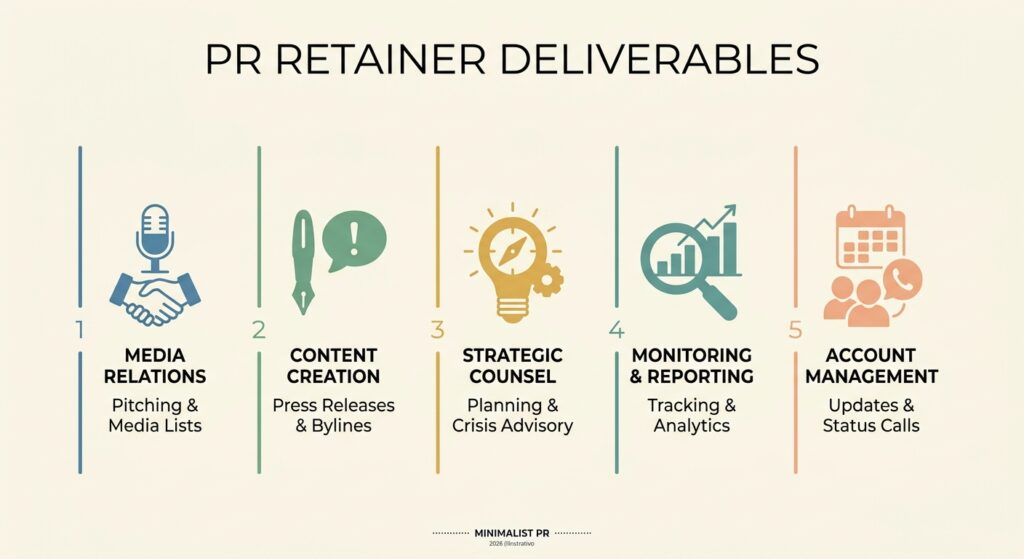
Quick answer: PR retainer deliverables commonly include a communications strategy, media list development, story angles, targeted journalist outreach, press materials, thought leadership support, media monitoring, account meetings, and performance reports. Depending on the agreement, they may also include digital PR, award submissions, speaking opportunities, social media support, or crisis communications.
The exact mix depends on your goals and budget. The essential distinction is between committed work (such as producing a pitch plan) and earned outcomes (such as receiving media coverage). Both matter, but only the former is generally under the agency’s direct control.
What Is a PR Retainer, and What Are You Paying For?
A PR retainer is an ongoing agreement in which a business pays an agency a recurring fee for an agreed scope of public relations services. Unlike a one-off project, a retainer reserves ongoing attention for strategy, media relationships, outreach, content, and counsel over several months or longer.
As Tori Schubert explains for Channel V Media, the services should be defined around the client’s needs, along with clear goals, reporting processes, fees, and contract terms. That is more useful than assuming every agency offers the same standard package.
Think of a retainer as a commitment to a working partnership, not a vending machine for news articles. It pays for the planning and professional work that make relevant coverage possible. But it should never be so vague that “ongoing PR support” becomes the only item on the invoice.
The Core PR Retainer Deliverables Checklist
Use this table to compare agency proposals. A service is not automatically included merely because it appears here; it should be explicitly marked as included, optional, or excluded in your statement of work (SOW).
| Deliverable | What you should receive | Suggested review cadence |
|---|---|---|
| PR strategy and messaging | Priority audiences, positioning, core narratives, story angles, and campaign objectives | At kickoff; refresh quarterly |
| Media list and research | A relevant, maintained list of journalists and outlets, with reasons for targeting them | At kickoff; update continuously |
| Media pitching | Approved pitch themes, tailored outreach, follow-ups, and an opportunity tracker | Weekly progress tracking |
| Press materials | Agreed press releases, media briefs, fact sheets, quotes, or press-kit updates | According to the editorial calendar |
| Thought leadership | Executive interview preparation, byline drafts, expert commentary, or contributed-article pitches | Monthly or campaign-based |
| Media monitoring | Relevant mentions, coverage links, publication details, and sentiment or message analysis when appropriate | Ongoing; summarized monthly |
| Digital PR | Link-worthy assets, digital publication outreach, earned backlink tracking, and content repurposing if in scope | Campaign milestones and monthly review |
| Account management | A named lead, status updates, approval requests, meeting notes, and next actions | Weekly or biweekly |
| Performance reporting | Completed work, coverage quality, opportunities in progress, relevant KPIs, insights, and next-month priorities | Monthly, with deeper quarterly review |
Some agencies also provide award entries, event publicity, spokesperson training, influencer relations, analyst outreach, social content, or crisis support. These are legitimate services—but not universal PR retainer deliverables. Ask which ones your fee actually covers.
Example: A Monthly PR Retainer Scope of Work
Here is an illustrative scope for a growing B2B company seeking consistent industry visibility. These quantities are negotiation examples, not industry averages or guaranteed performance standards.
- Strategy: one monthly planning session plus an updated 90-day editorial calendar.
- Story development: two or three prioritized angles aligned with the company’s product, expertise, or market news.
- Media relations: an agreed batch of targeted pitches and appropriate follow-ups, recorded in a shared tracker; quality takes priority over raw send counts.
- Content: one press-release draft, executive byline draft, or media brief each month, as selected in the plan.
- Expert opportunities: timely responses to suitable journalist requests when relevant expertise is available.
- Communication: one weekly status update and a regular check-in with a named account lead.
- Reporting: one monthly report with published coverage, open opportunities, message quality, referral activity where measurable, and recommended next steps.
- Review: a quarterly strategy reset to adjust the mix of activities in response to results.
The agency can commit to drafting content, completing agreed research, maintaining a tracker, and carrying out approved outreach. It can set placement targets, but should explain that editors make independent publication decisions. If an agency guarantees a precise number of earned news stories, ask how it can make that promise and whether paid or sponsored coverage is involved.
PR Retainer Deliverables by Month: A Six-Month Roadmap
Results rarely arrive in a neat monthly pattern. Month one often establishes the foundation; later months test whether the agency can turn that groundwork into repeatable opportunities. In his six-month digital PR breakdown, senior PR strategist Timothy Carter emphasizes onboarding, first outreach signals, a 90-day assessment, compounding results, and a clear renewal decision.
The following adapts that progression into a more general PR planning framework, rather than imposing digital-link benchmarks on every type of PR program.
| Month | What the agency should be working on | What to review together |
|---|---|---|
| 1: Foundation | Kickoff, message framework, stakeholder interviews, media research, angle development, measurement baseline | Approved strategy, priority media list, editorial calendar, responsibilities, and access to spokespeople |
| 2: Outreach | Targeted pitching, timely commentary, journalist introductions, first content assets | Pitch relevance, journalist interest, responses, feedback, and opportunities progressing |
| 3: Evaluate | Continue outreach, publish or pitch stronger assets, review narrative fit | 90-day scorecard: work completed, coverage quality, missed opportunities, and strategy changes |
| 4: Build | Follow-on angles, deeper relationships, distribution and repurposing of existing coverage | New opportunities, continued pickup, quality of coverage, and relevant website or search signals |
| 5: Improve | Refine winning topics, launch additional proof points, pursue thought leadership | Which stories resonate, how efficiently opportunities progress, and whether messaging is consistent |
| 6: Decide | Summarize results, identify gaps, propose the next strategy | Renew, renegotiate, or end the retainer based on documented performance and business priorities |
Important: these are planning milestones, not promised publication dates. An emerging company with little news may need more message and asset development. A brand with a major launch may see opportunities earlier. Evaluate the trajectory and quality of work against the agreed plan.
How to Measure PR Retainer Deliverables Without Getting Lost in Vanity Metrics
Imagine two agencies. The first sends 200 broad pitches and earns mentions in publications your customers never read. The second sends fewer, carefully researched pitches and earns one thoughtful article that your sales team shares with prospective buyers. Which one delivered more value?
The answer depends on your objective. That is why your monthly report should distinguish activity, quality, and business outcomes.
| Measurement level | Useful PR KPIs | What the numbers mean |
|---|---|---|
| Work completed | Approved assets, tailored pitches, reporter conversations, completed briefings | Shows whether the agency delivered its contractual commitments |
| Earned results | Relevant placements, message inclusion, quality of outlet, share of voice, linked coverage | Shows whether the work earned credible attention in the right places |
| Audience response | Referral traffic, engaged visits, branded-search trends, content engagement | Indicates how audiences may be responding; attribution requires care |
| Business contribution | Qualified inquiries, demo requests, sales use of coverage, influenced opportunities | Connects PR to business priorities without assuming every conversion was caused by PR |
Axia Public Relations warns that retainers can drift when scopes reward activity rather than meaningful outcomes. Its recommendation is to connect PR work to the wider marketing calendar, buyer journey, and reporting system—not to treat a long list of clippings as proof of revenue impact.
For measurement design, the AMEC Integrated Evaluation Framework distinguishes outputs, audience response, outcomes, and impact. It is also worth avoiding advertising value equivalents (AVEs) as an alleged measure of PR return: AMEC’s Barcelona Principles 4.0 explain the limitations of that approach.
Practical reporting tip: create a coverage log with the outlet, URL, publication date, audience relevance, key message, link information where applicable, and any observable response. Pair it with a short narrative: What worked? What did not? What will change next month?
What Your PR Retainer Agreement Should Say
A beautifully written proposal is not enough. Before signing, check that the PR agency scope of work answers these questions:
- Objectives: What business or communication goal does each workstream support?
- Included deliverables: Which specific documents, activities, and services will the agency produce?
- Cadence and ownership: How often will work happen, who is responsible, and when will it be reviewed?
- Approvals: Who provides access to executives, brand information, fact-checking, and legal sign-off? How long do approvals take?
- Changes: What happens if priorities change mid-quarter? Can the scope be rebalanced through written agreement?
- Reporting: Which KPIs, definitions, tools, and attribution assumptions will appear in the scorecard?
- Extras: Are newswire distribution, paid placements, travel, award entry fees, design, and outside vendors excluded or billed separately?
- Terms: What are the payment schedule, notice period, termination rules, confidentiality obligations, and ownership or use rights for created materials?
Schubert’s retainer guide specifically addresses reporting, fees, additional expenses, termination, and confidentiality. These details may sound less exciting than a front-page media hit, but they become very important the first time a launch shifts, an approval is delayed, or an unexpected invoice arrives.
What Is Usually Not Included in a PR Retainer?
Never assume that a monthly PR fee automatically covers every communications need. Depending on the agency and contract, the following may require a separate budget or written change order:
- Newswire distribution charges and other third-party distribution costs.
- Award submission fees, event registrations, travel, or production expenses.
- Paid media, sponsored articles, influencer fees, and advertising spend.
- Full-scale crisis response, after-hours support, or litigation communications.
- Large research studies, video shoots, design projects, or new website development.
- Unlimited content revisions, executive social media management, or services beyond the stated scope.
These are possible exclusions, not a universal rule. Ask your agency to document them. A transparent retainer should make the total expected cost easier to understand before work begins.
Six PR Retainer Red Flags to Watch For
- “Ongoing outreach” with no definition. Ask what targeted outreach looks like, what is tracked, and how the strategy is approved.
- Only activity numbers are reported. Counting emails without examining relevance, interest, and outcomes can reward busywork.
- Coverage is guaranteed without explanation. Confirm whether promised mentions are editorial, syndicated, sponsored, or paid.
- Every month starts from zero. Good media relationships and stronger narratives should build over time rather than disappear after each campaign.
- The scope ignores your business goals. A pile of mentions is not automatically useful to buyers, partners, or the sales team.
- There is no process for changing direction. Strategy should evolve when your product, market, or evidence changes.
If your engagement has drifted, you do not necessarily have to cancel it immediately. A 60- to 90-day review can identify which work to preserve and which to change. Axia Public Relations recommends reviewing current activities against original goals and rebalancing the scope toward meaningful contributions.
How to Choose the Right PR Retainer Deliverables for Your Business
Do not begin with the question, “How many press releases do we get?” Begin with: Who are we trying to influence, and what do we need them to understand?
If you are a startup entering a category, messaging, founder credibility, and targeted journalist relationships may deserve most of the early work. If you sell complex B2B software, an expert byline in the right trade publication may help more than a generic mention in a broad consumer outlet. If search visibility is a priority, digital PR assets and quality referring domains may be relevant—but only when those links support a bigger audience and brand strategy.
The right deliverables are the ones you can explain to a colleague without pulling up a 40-slide report. Every promised activity should have a purpose. Every major result should tell you something useful about your market.
Frequently Asked Questions About PR Retainer Deliverables
How many deliverables should a PR agency provide each month?
There is no universal number. It depends on the fee, complexity, industry, team capacity, and strategy. Ask for an agreed work plan with clear outputs and realistic timing rather than comparing agencies solely by the number of press releases or pitches.
Should media placements be guaranteed in a PR retainer?
Earned editorial placements are generally not fully within an agency’s control. Agencies can commit to qualified research, content preparation, outreach, follow-up, and reporting; placement targets should be labeled as goals. Any guaranteed publication arrangement should be explained and distinguished from independent earned coverage.
What should a monthly PR report include?
A useful report includes work delivered, ongoing opportunities, relevant earned coverage, coverage quality, progress against KPIs, lessons learned, and next steps. It should state measurement limitations and explain what the team will do differently.
How long should a PR retainer run before you evaluate it?
Evaluate execution from the first month, conduct a structured strategy review around 60 to 90 days, and assess larger trends over a longer period when appropriate. Do not confuse patience with a lack of accountability: even during onboarding, clear deliverables should arrive.
Can PR retainer deliverables change during the contract?
Yes, when both parties agree. A written change process can shift effort from low-impact tasks toward stronger opportunities while documenting effects on budget, schedules, and responsibilities.
Are media monitoring and crisis communications included?
Media monitoring is commonly part of ongoing PR services, but its tools and depth vary. Crisis communications and after-hours availability are often scoped separately. Both should be explicitly addressed in the agreement.
The Best Retainer Is One You Can Understand and Defend
By the time next month’s report arrives, you should not have to decode what the agency did. You should be able to point to the strategy, the work delivered, the relationships developing, the coverage earned, and the questions still unanswered.
That is what well-defined PR retainer deliverables offer: clarity for the person paying the invoice and a fair standard for the team doing the work. Before signing or renewing, take the checklist in this article into your next agency meeting. Ask what is included, what is excluded, how progress will be measured, and what you will change if the plan stops working.
The goal is not a longer list of tasks. It is a stronger story, told to the right people, with evidence that the work is moving in the right direction.
Sources and Further Reading
- Tori Schubert, “What’s Covered in PR Agency Retainer?” — Channel V Media. Scope, goals, reporting, fees, expenses, confidentiality, and termination.
- Timothy Carter, “What a Six Month Digital PR Retainer Should Deliver by Month” — PR Digital. Milestones and review points for digital PR engagements.
- Axia Public Relations, “PR Retainer Red Flags”. Contract drift, pipeline alignment, and scope resets.
- AMEC, Integrated Evaluation Framework. Measuring communication outputs, outcomes, and impact.
- AMEC, Barcelona Principles 4.0. Best-practice measurement and limitations of AVEs.