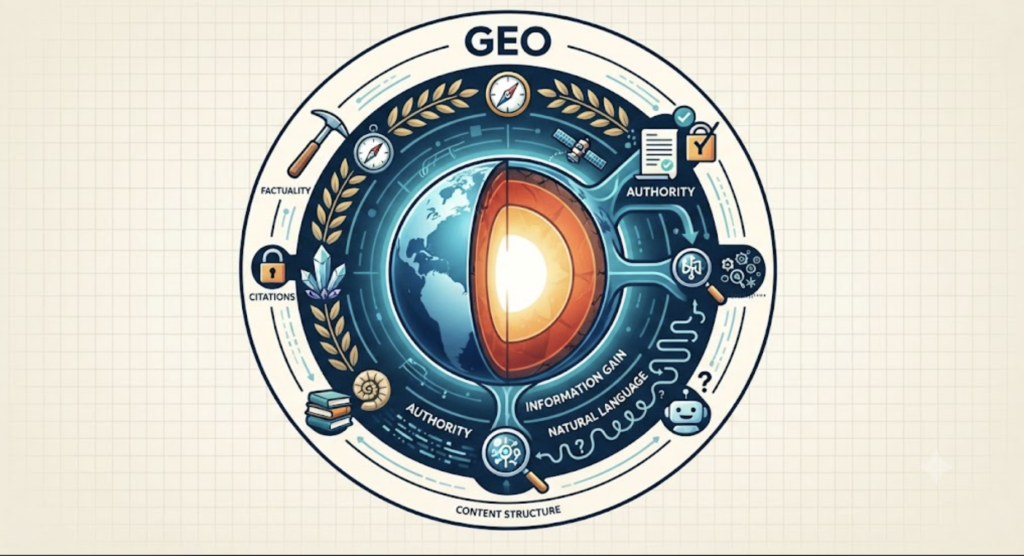
Your buyers are asking questions. They are not asking Google.
They are asking ChatGPT, Perplexity, Gemini, and Claude — and they are receiving a finished answer instead of a list of links. That answer names some brands and omits others. If yours is missing, you lost the consideration set before anyone clicked anything.
This is the problem Generative Engine Optimization (GEO) exists to solve. And the discipline best positioned to solve it is not SEO. It is public relations.
Key Takeaways
- GEO is the practice of making a brand findable, understandable, and citable by AI systems — not just rankable by search engines.
- Earned media is the dominant citation source. Muck Rack’s research puts roughly 99% of AI-cited links on non-paid sources, with about 84% coming from earned media. Bolt PR cites a comparable index at 82% earned versus 6% paid or owned.
- Search behavior is already moving. Gartner projects traditional search volume will fall 25% by 2026 as conversational AI absorbs informational queries.
- Verifiable beats persuasive. Structured, data-anchored, machine-readable content outperforms polished marketing prose in AI answers.
- The metrics change. AI share of voice, citation frequency, source attribution, and GEO sentiment now sit alongside placements and reach.
- GEO is not a new headcount. It is a new lens applied to pitching, narrative discipline, and monitoring — work your team already does.
What Is Generative Engine Optimization (GEO)?
Generative Engine Optimization is the practice of structuring content, reputation, and communications activity so that generative AI systems interpret a brand correctly and include it in their responses.
The term was formalized by researchers at Princeton, Georgia Tech, and IIT Delhi, who demonstrated that specific optimization techniques could measurably lift a brand’s presence in AI-generated answers.
In practice, GEO answers three questions:
- How does AI describe our company?
- Which sources is it drawing from?
- Will it recommend us — and to whom?
Note what is absent from that list: rankings, click-through rate, and page position. GEO succeeds when a model names you, whether or not anyone visits your site.
GEO vs. SEO: A Structural Difference, Not a Cosmetic One
Many communications teams assume the SEO function owns GEO because both involve search. The distinction is structural.
| SEO | GEO |
|---|---|
| Optimizes for search engines | Optimizes for AI-generated answers |
| Goal: website traffic | Goal: AI mentions and recommendations |
| Measured by rankings | Measured by AI visibility and citation share |
| Focuses on keywords and ranking signals | Focuses on context, credibility, and citeability |
| Controlled by on-page signals | Determined at inference time by third-party authority |
SEO works on signals a team controls directly: meta tags, schema markup, keyword targeting. GEO is decided at the moment of generation, based on which external sources the model treats as trustworthy.
No amount of meta tag optimization changes what a journalist publishes about your brand. That is the entire point — and it is why the optimization work has moved into PR territory.
SEO is not disappearing. It is being joined by a second layer of digital visibility.
Why PR Owns GEO
Generative models do not weight all content equally. They privilege third-party validation over self-description, which inverts the usual hierarchy of communications assets.
Your brand blog is not competing on equal terms with a byline in a respected trade publication. The model has already decided which one it trusts.
The evidence is consistent across sources:
- Muck Rack research: approximately 99% of AI-cited links come from non-paid media, with earned media accounting for roughly 84% of all citations.
- Bolt PR, citing an AI brand visibility index: up to 82% of AI citations originate from earned media channels, against roughly 6% from paid or owned platforms.
The exact figures vary by methodology, and you should attribute them carefully in your own reporting. The direction does not vary. Editorial coverage, expert commentary, industry research, and encyclopedic references are the raw material AI systems reach for.
UX researcher Jakob Nielsen framed the stakes bluntly: being ignored by AI is the modern equivalent of ranking on page five of Google.
PR is the only function that earns the coverage AI models prefer. That makes GEO a PR strategy question first and a technical question second.
How to Build a GEO-Ready PR Strategy
Earn Coverage in the Outlets AI Actually Cites
Not every placement contributes equally. Emerging benchmarks evaluate source influence across dimensions like exposure, faithful credit, and causal impact on answer quality. Authoritative national and trade publications tend to perform well, though the pattern shifts by industry and query type.
Audit your media list against where models actually pull information before you build the next outreach plan.
Keep the Narrative Identical Across Every Source
LLMs look for consensus. When several reputable outlets carry the same core claim, the model treats it as fact.
Inconsistent messaging across trades, national outlets, and podcast transcripts creates noise the model cannot resolve cleanly. One placement rarely establishes consensus; the same claim from multiple independent outlets over a reasonable window does.
Repetition with authority is a GEO signal. Repetition without authority is noise.
Brief Spokespeople So Their Expertise Extracts Cleanly
A 2025 Gartner survey found 51% of consumers changed how they research because of generative AI, and 26% now use question-shaped inputs. Models pull expert statements in direct response to those questions.
The practical implication for briefing documents:
- This extracts: “The challenge most operations directors face is…”
- This does not: “Our platform helps customers…”
Brief spokespeople to answer the question a buyer would ask, not to deliver a talking point.
Pitch With Recency in Mind
Recency is one of the clearest GEO signals available to a communications team. A placement from last quarter carries less weight than one from last week when a model resolves a time-sensitive query.
Tie pitches to a news hook, a data release, or a live event. Journalists have always cared about the hook. Now the model weights it too.
Anchor Every Claim in Verifiable Data
AI favors information it can verify. Academic research suggests introducing concrete statistics and original data can improve citation likelihood by roughly 30% to 40%.
Replace this: “We are the largest and fastest-growing provider in the category.”
With this: “We operate in 12 markets and serve more than 2,500 clients.”
The second sentence is citable. The first is unusable.
Structure Owned Media for Machines and Humans
Owned media still matters — it remains the authoritative source for your own narrative, and models use it when it is clear and current.
- Use descriptive H2 and H3 headings, short paragraphs, and bullet lists.
- Add dedicated FAQ sections that answer real user questions.
- Publish press releases, expert profiles, case studies, and methodologies as indexable HTML — not locked inside PDFs or rendered through heavy JavaScript that crawlers routinely fail to parse.
- Write explicit subject-verb-object constructions. Ambiguity produces inference errors.
- Update regularly. Stale content leaves a gap that AI will fill from a less accurate source.
Map the Sources You Are Not Watching
AI visibility audits repeatedly surface a surprise: models draw on sources companies never monitor. Industry publications, encyclopedic resources, review platforms, discussion forums, community sites, and old articles that no longer rank at all.
This has a reputation dimension. In traditional search, negative content could be gradually displaced by newer material. In AI environments, an outdated forum thread can keep shaping generated answers long after it has vanished from page one.
You do not need to participate on every platform. You do need to know where the conversation about your brand lives, and whether it is influencing what AI says about you.
How to Measure GEO Alongside Traditional PR KPIs
GEO is measurable. These metrics complement your existing outputs rather than replacing them.
- AI Share of Voice — how often your brand appears in AI answers relative to competitors, tracked over time.
- Citation frequency and source attribution — which specific URLs, outlets, and journalists the model references when describing you.
- GEO sentiment — how you are characterized. A brand cited often but negatively is a fundamentally different problem from a brand that is absent, and each demands a different response.
- Referral traffic from AI domains — visible in analytics, though it will understate impact in a zero-click environment.
- Unlinked brand mentions — increasingly a leading indicator rather than a rounding error.
Treat it as a loop, not a project: measure → analyze → adjust → communicate → measure again.
Start manually if you need to. Query the models your buyers use with the questions they actually ask, record the answer, and note the sources. That single exercise will show you where the gaps are. Scaling across multiple engines, tracking sentiment over time, and attributing citations at the source level is where dedicated tooling starts to earn its cost.
Four Pitfalls to Avoid
- Applying SEO volume logic to GEO. Publishing more brand-owned content will not raise citation rates. Gartner expects models to weight quality more heavily as low-quality AI-generated content proliferates. Scaling output without building authority moves you backwards.
- Assuming storytelling is sufficient. Narrative craft still matters for humans. Models need structured, verifiable, cross-referenced facts. Compelling prose alone does not produce algorithmic trust.
- Optimizing for one engine. Citation overlap between platforms is low. A strategy built around ChatGPT alone leaves most of the landscape unmonitored.
- Burying your best material in PDFs. If your methodology, research, or executive profiles live only inside a downloadable document, assume they are invisible.
A Necessary Note on the Hype
GEO is an unsettled field, and practitioners are right to be skeptical of it.
A recurring theme among working communicators is that much of what circulates under the GEO label is theorizing rather than teaching, often produced by vendors with a product to sell. The most useful mechanical detail tends to appear under different terminology — “LLM visibility” and “AI citation” — in technically-oriented newsletters rather than in PR-branded thought leadership.
Hold two things at once. The underlying shift in discovery behavior is real and measurable. The certainty with which any single framework claims to have decoded the black box is not. Read the vendor research, note that the citation percentages differ between studies, and verify against your own category by querying the models directly.
Skepticism here is not a reason to wait. It is a reason to measure your own baseline rather than accept anyone else’s.
Frequently Asked Questions
What is the difference between GEO and SEO?
SEO optimizes a website to rank in search results and drive traffic to it. GEO structures content and reputation across the web so AI tools cite and credit your brand inside their generated answers, whether or not a user ever clicks a link.
Which platforms does GEO target?
Conversational assistants and hybrid search features: ChatGPT, Perplexity, Google Gemini, Google AI Overviews, Claude, and Microsoft Copilot.
Do press releases still matter if AI prefers editorial coverage?
Yes, but their function shifts. A press release is less a citation target in itself than the raw input that produces the editorial coverage models cite — and a structured, data-anchored release produces better coverage.
Is GEO relevant for smaller organizations?
Arguably more so. Consensus across a handful of credible, specialized trade sources is achievable at any budget, and it matters more to a model than paid reach does.
How quickly does earned media influence AI answers?
It varies by engine and by whether the model is retrieving live sources or drawing on training data. Retrieval-based systems can reflect new coverage within days; training-based influence takes considerably longer.
Rethink What You Are Reporting
The uncomfortable question for most communications teams is not whether they can do GEO. They already have the skills. It is whether their reporting still measures anything that matters.
If your quarterly deck opens with impressions and closes with domain authority, it is describing a discovery model that is quietly being replaced. Every pitch you send is now two conversations at once: one with a journalist, and one with the systems that will summarize that journalist’s work for your next buyer.
Start with the baseline. Query the engines your audience uses, with the questions they actually ask, and record what comes back. Then ask what your current measurement framework would have told you about that — and what it missed.

Leave a Reply