
A growth-and-IR hire at an India-based fintech recently posted a question that a lot of people are quietly living: the company’s Series B lands in four to six weeks, the announcement has been handed to him, and he has zero comms experience. He asked for the unwritten rules. Half the replies told him to hire someone. That’s not wrong — but it’s also not usable if the round closes in a month and you’re the one holding it.
Here’s the version that is usable: the sequence, the judgment calls, and the two or three decisions that actually determine whether your round produces coverage, pipeline, and hires — or a one-line mention in a deal newsletter.
Before anything else: is the round the story?
The most useful test in funding PR takes ten seconds. Remove the dollar figure from your announcement. Would anyone still care? If the answer is no, you’re announcing a bank transaction, and no amount of media outreach will fix that.
A Series B is a fact. The story is what the money makes possible, or what made the money inevitable. The strongest announcements bundle the raise with something else — a product milestone, an unusual customer result, a senior hire, a contrarian market thesis the round validates. The round becomes evidence for a claim rather than the claim itself.
So the first conversation isn’t with a journalist. It’s with your CEO:
- What are the core business objectives this capital unlocks? New market? New category?
- Why now? What changed in the market that makes this round the logical consequence?
- Who are we actually trying to reach — buyers, senior candidates, existing customers, or our next investors?
At Series B specifically, you’re buying category ownership and enterprise trust. That’s a different job than a seed round (credibility) or a Series A (pipeline), and it means the narrative has to hold for four audiences at once.
There’s also a readiness question worth asking honestly before you pick a date. Are you actively hiring? Is the product mature enough to absorb new customers this quarter? Are you positioned for the next round? A funding announcement is a free media event, and its entire value is the inbound it generates. If you can’t absorb inbound, consider delaying.
Step 1: Match your target list to your raise size
This is where first-timers waste the most effort — pitching tier-1 business press on a round those outlets were never going to cover. Coverage tiers track deal size fairly predictably:
| Raise size | Realistic target | Likely outcome |
|---|---|---|
| Under ~$3M | Daily deal newsletters (e.g. Axios Pro Rata) | One-line mention, usually linking to your release |
| ~$3M–$25M | Industry and tech trade press | Short feature or full article |
| ~$25M+ | Major business press | Multi-outlet news cycle |
Two honest caveats. First, practitioners disagree on the top threshold — some report legacy outlets engaging around $25M, others say the bar at the largest wires is closer to $100M, and a known founder can move a $15M round into coverage that a first-time founder can’t. Second, outlet reputations go stale fast. Some publications widely assumed to cover financing rounds have quietly stopped, or only mention them in a newsletter. Check a target’s last four weeks of output before you put them on the list, rather than trusting a list you inherited.
Geography matters too. A regional company pitching foreign outlets needs a genuine regional angle for that market — local investors, local expansion, local relevance — not just a good story told from elsewhere.
Build the full list before you send anything. (Our [media list building guide] covers how to structure targets by tier and beat.)
Step 2: Decide exclusive vs. embargo — and how much to disclose
The exclusive. Offer one tier-appropriate outlet the story first, with a 24–48 hour deadline to accept. A tight window is not rude; it’s standard, and without it you’ll still be waiting on a “maybe” three weeks out. If a tier-1 outlet takes the exclusive, it will get picked up elsewhere anyway.
The embargo. Everyone else gets the release under embargo, timed to lift at your launch hour. Give reporters at least one to two weeks — they need it for their writing schedule and their editor’s queue. Then push the release broadly the same day the exclusive goes live.
A warm intro beats a cold pitch every time. Reporters covering financing rounds are buried in these emails. Your investors almost certainly have journalist relationships; ask them to make introductions. This is the single largest thing an agency’s contact book buys you, and the reason so many ex-journalists work in comms.
How much do you reveal in the pitch email?
Here the practitioners genuinely split, and it’s worth understanding both positions:
- The coy approach: in your initial exclusive offer, give a ballpark figure or the marquee investor name — but not both. Hold the full detail until the reporter shows interest, so the pitch retains a reason to reply.
- The transparent approach: a working journalist’s counter is blunt — most won’t engage at all without the amount raised and the investors, because without those they can’t judge whether it’s a story.
The reconcilable version: be specific enough to be evaluated, coy only about precision. “Eight figures, led by [recognisable fund]” gives a reporter enough to decide. “A significant round from top investors” gives them nothing and reads like every other email in the inbox.
One more thing, since it’s now a live issue: don’t send AI-generated pitches. Reporters have received thousands and have gotten very good at spotting them. A generic, over-polished email is now a negative signal, not a neutral one.
Step 3: Build the press release and the asset kit
Your release should lead with the funding amount and participating investors, then get immediately to substance. Include:
- What the product is, who uses it, and what they did before it existed
- How the funds will be used — specific plans, not “accelerate growth”
- Traction metrics vague enough to protect competitive detail, specific enough to be real (millions in revenue, hundreds of customers, 10x growth)
- A quote from the CEO and a quote from someone at the lead investor
- A customer quote, if you can get one cleared in time
- Hiring plans — Series B is a recruiting moment, and most releases waste it
- A named press contact, plus a press section on your site and high-resolution landscape imagery
A skeleton release
Headline: [Company] raises $X to scale [vision] for [ideal customer] Subhead: Founded by [founder], [Company] is reshaping [market] with a platform trusted by [customer types] Problem: Before [Company], [these teams] had to [bad workaround] Solution: Now they can [better outcome] with [less time/cost/headcount] Traction: Used by [range] customers across [industries]; [growth metric] Quote — CEO: the why-now and the vision Quote — Lead investor: why this team, this category, this moment Quote — Customer: the concrete outcome Close: how prospective customers and candidates get in touch
On the wire service: it costs roughly $1,000 and it guarantees distribution, not coverage. Outlets rarely write from a wire release alone unless the round is significant. Budget it as a completeness measure, not a strategy.
Step 4: Treat announcement day as a sequence
Impressions on an announcement peak inside the first 48 hours and then fall off hard, and social platforms decide how far to push a post based heavily on its first thirty minutes. Publishing cold at 9am and going back to work is how good rounds land badly. A shape that works:
- T−24h: brief anyone amplifying. Warm the founder’s account with a related post so it isn’t waking from three weeks of silence.
- T−1 day: email employees, investors and stakeholders — tell them the timing and ask them to hold their posts until the founder posts first.
- T−0: the founder posts first, from their personal account, in their own voice. Personal accounts outperform brand accounts on both reach and trust.
- T+15m: the coordinated first wave — investors, employees, partners — each with their own framing rather than identical copy.
- T+2h: the trade article goes live and gets amplified into an audience already primed, instead of into a vacuum.
- T+24h: founder posts a follow-up — a detail, a number, a reply to the best critique.
- T+48h: reply to every qualified comment and DM. This is where the round becomes pipeline, and it’s the step most teams skip entirely.
Send a second stakeholder email once you’re live, with links to every artifact and suggested post copy for the people in your network with the largest followings. Then keep going for one to two weeks with customer stories and founder background posts.
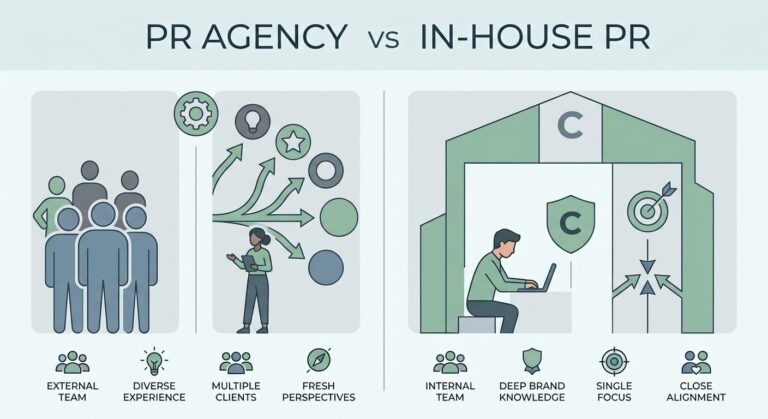
Step 5: Is an agency worth it four weeks out?
Neither an agency nor an experienced freelancer is too late to secure at four to six weeks — and if you’ve never done this, the relationships alone often justify it. But evaluate on specifics, not process. Ask:
- Can they run an investor narrative and a customer narrative simultaneously without either going flat? “We keep messaging consistent” means they haven’t done it.
- Have they managed news during a funding announcement — a leaked round, a slipping embargo, an investor going off-message — not just the coverage after?
- Do they already understand your regulatory environment? In fintech, you don’t want to spend the first 60 days teaching them what can’t be said.
Red flags: “we’ll figure out the narrative once we see the press release,” any guarantee of a specific outlet, and scoping deliverables before asking about your business. (See our [criteria for choosing a funding-round PR partner] for the full framework.)
The mistakes that cost the most
- Leading with the number. The amount is the least interesting fact about the round.
- Thanking investors in the first line. It signals the post is for the cap table, not the buyer.
- Announcing from the company account instead of the founder’s.
- Treating the embargo as the finish line. The article going live is the midpoint.
- Stacking news — funding plus a product launch plus a partnership in one release dilutes all three.
- Ignoring customers and candidates, who are the audiences most likely to act.
- Letting the comments sit. The inbound is in the replies.
Track qualified inbound, reply quality (twenty replies from named operators at target accounts beats two thousand anonymous ones), demo requests and applications in the fourteen days after versus before, and follower growth on your own accounts. Ignore raw impressions in isolation.
Your announcement is one day. The narrative you build around it is what people remember in month three.

Leave a Reply