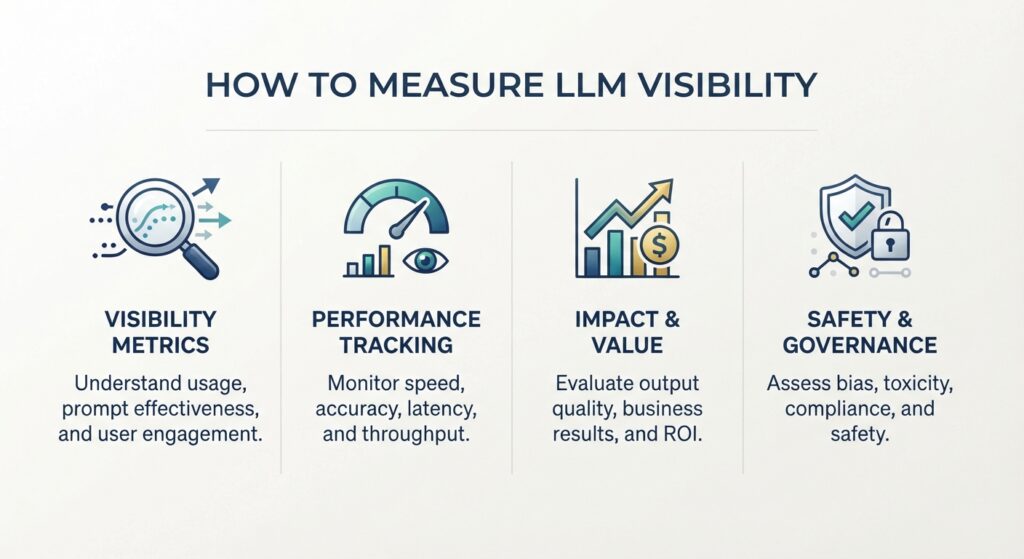
Everyone in PR and marketing now knows that AI assistants lean heavily on earned media. News coverage, press releases, analyst mentions, and third-party reviews all feed the answers that ChatGPT, Gemini, Claude, and Perplexity give to buyers. Knowing this is easy. Proving it to management is hard. LLM visibility has become one of the most discussed measurement problems in the industry, and the question keeps coming up: how do you show that your campaigns are actually influencing what AI says about your brand?
This guide pulls together practical frameworks shared by PR professionals, agency teams, and AI practitioners in internet forums. It turns them into a step-by-step process you can use this quarter.
What Is LLM Visibility?
LLM visibility is how often, and how prominently, your brand shows up in answers generated by large language models. It covers three things. The first is whether your brand is mentioned at all. The second is where it ranks when the AI lists several options. The third is which sources the AI cites when it talks about you.
Tracking this is the measurement side of generative engine optimization (GEO), which is the practice of shaping your content and earned media so AI systems surface and recommend your brand.
Why Measuring AI Citations Is Harder Than Media Monitoring
Traditional media monitoring works because an article is a fixed object. It exists or it doesn’t. AI answers are not fixed. The same question can produce different responses depending on the model, the user’s location, their conversation history, and plain randomness in how the model generates text.
This is why forum discussions on the topic are full of frustration. Several professionals reported testing multiple paid monitoring platforms side by side and getting wildly different numbers for the same brand. Others argued that no tool can truly capture what individual users see, because every answer is personalized. A more balanced view came from people who use these tools daily. They said the tools are useful for spotting trends but shouldn’t be treated as precise truth.
The lesson is simple. You can’t measure AI citations the way you measure clippings. You need a repeatable method that accounts for variability.
Step 1: Build a Prompt Set Based on Real Buyer Questions
Start with a fixed list of questions your customers actually ask when they’re looking for a solution like yours. AI can help you brainstorm, but the strongest lists come from real data: sales call notes, support tickets, search console queries, and onboarding surveys.
One tip that came up repeatedly in forum threads is to weight each question by revenue importance. Suppose 90% of your revenue comes from one use case and 10% from another. The first group of prompts should count far more in your reporting. This turns a vanity metric into a business metric.
Step 2: Run Prompts Across Multiple LLMs on a Fixed Cadence
Run your full prompt set through the major assistants, such as ChatGPT, Gemini, Claude, Perplexity, and Grok. Do it on a regular schedule, usually weekly. Because answers vary, experienced teams don’t rely on a single run per prompt. They repeat each prompt enough times to get a statistically meaningful picture.
For every run, record three things: the full answer, whether your brand appears and in what position, and every URL the model cites as a source.
Step 3: Score Visibility, Ranking, and Cited Sources
Raw answers pile up fast, so you need a scoring model. Common metrics include the following.
Mention rate is the percentage of prompts in which your brand appears. Average position is where you rank when the AI lists several brands. Share of voice is your mentions compared with competitors across the same prompts. Source mix shows which domains the AI cites when it discusses you, such as your own site, trade media, review platforms, or analyst reports.
Agency teams in these discussions described feeding this data into a filterable dashboard. That way they could show clients not just how visible a brand is, but why it’s visible and where the gaps are. Source mix is often the most revealing metric. Many B2B SaaS companies are surprised by which publications and platforms the models actually rely on.
Step 4: Separate Visibility From Attribution
This is the step most teams skip, and it’s the one that makes your report credible.
Seeing your brand in an AI answer doesn’t prove your PR campaign put it there. SEO work, product reviews, community discussions, and model updates can all move the numbers. One AI practitioner in a forum thread suggested running a control set alongside your main prompts. This is a small group of questions unrelated to the campaign you’re launching.
Capture both sets before the launch and again afterward. Suppose your campaign themes start showing up in answers to related prompts while the control set stays flat. Then you have real evidence that the campaign contributed. Frame it that way to leadership: this is evidence of contribution, not perfect attribution.
Step 5: Track PR Impact at the Claim Level
To show that your PR content is being sourced, and not just that your brand appears, go one level deeper and track specific claims.
Each campaign places particular facts in earned coverage: a statistic, a customer result, a product positioning line, or a quote from an executive. Log those exact claims and the URLs where they were published. Then check whether AI answers repeat the claim and cite the same article, or a site that syndicated it.
A repeated “content fingerprint” plus a matching source URL is the strongest evidence you can currently get that your PR material entered the model’s answer. Design future press materials with this in mind. Include distinctive, quotable data points that are easy to trace.
Step 6: Connect LLM Visibility to Pipeline
Some practitioners argue that for B2B companies, the only metric that truly matters is new customers and booked meetings. Visibility data becomes much more persuasive when you pair it with downstream signals like these:
- Add “AI assistant” as an option in your “How did you hear about us?” field on sign-up and demo forms.
- Monitor referral traffic from AI platforms in your analytics, since some assistants pass identifiable referral data when users click through.
- Check your webmaster and search console tools for any AI-related citation or referral reporting they offer.
Even directional pipeline data helps management connect AI visibility to revenue.
Should You Buy a Tool or Build Your Own?
Both paths came up often in forum discussions.
Buying a tool. Major PR and SEO platforms, including media monitoring suites and dedicated GEO trackers, now offer LLM monitoring. Pricing is often based on how many tracked prompts or saved searches you run. These tools save setup time, but results can differ a lot between vendors. Before you commit, ask each vendor how they run prompts, how many times, and from which locations.
Building your own. A surprising number of professionals said they built their own tracker with AI coding assistants. The basic setup is a script that sends your prompt set to each model’s API on a schedule, logs the answers and citations to a spreadsheet or database, and scores the results. API costs for a modest prompt set are often just a few dollars a month. Building your own also gives you full transparency into the method, which makes the data easier to defend.
A hybrid approach often works best. Use a commercial tool for broad trend monitoring and a custom tracker for campaign-specific attribution tests.
The Limits of Any Generative Engine Optimization Metric
Stay honest about what these numbers can and can’t tell you. Any AI citation data is a snapshot of what a model said at a given moment, under specific conditions. Models change, answers drift, and no outside method sees exactly what every user sees.
That’s why the fundamentals of good PR still apply. Earn coverage in publications your target audience genuinely reads and trusts. Publish content that adds real value. Make your key claims specific and verifiable. Those are the same qualities that make sources attractive to AI systems.
How to Report LLM Visibility to Management
A simple quarterly report structure works well:
- Revenue-weighted mention rate and average position, compared with competitors.
- Changes in campaign-related prompts against the control set, before and after each launch.
- Claim-level evidence: specific PR facts that appeared in AI answers, with the cited URLs.
- The top cited sources for your category, with gaps to target in future outreach.
- Pipeline signals from AI referrals and self-reported attribution.
This moves the conversation from “we think AI is picking up our coverage” to “here is the evidence, here is the trend, and here is where we should invest next.”
Frequently Asked Questions
What is LLM visibility?
LLM visibility measures how often and how prominently a brand appears in answers from AI assistants such as ChatGPT, Gemini, and Claude, including which sources those assistants cite.
How do you measure AI citations?
Run a fixed set of real buyer questions through multiple AI models on a regular schedule. Record the answers and cited URLs, and score mention rate, ranking position, and source mix over time.
Can PR teams prove they influence AI answers?
Not with perfect attribution. But combining a control prompt set, before-and-after measurement, and claim-level tracking of specific facts from earned coverage gives strong evidence of contribution.
Is generative engine optimization the same as SEO?
They overlap but aren’t identical. SEO focuses on ranking in search results. Generative engine optimization focuses on being mentioned and cited in AI-generated answers. Earned media and third-party validation play an especially big role in GEO.
Conclusion
Measuring LLM visibility isn’t about finding one perfect number. It’s about building a consistent, defensible process: real buyer prompts, repeated runs across models, clear scoring, control sets, and claim-level tracking. Put that process in place and you’ll be able to show leadership how your PR work shapes what AI tells your future customers, with evidence rather than assumptions.

Leave a Reply