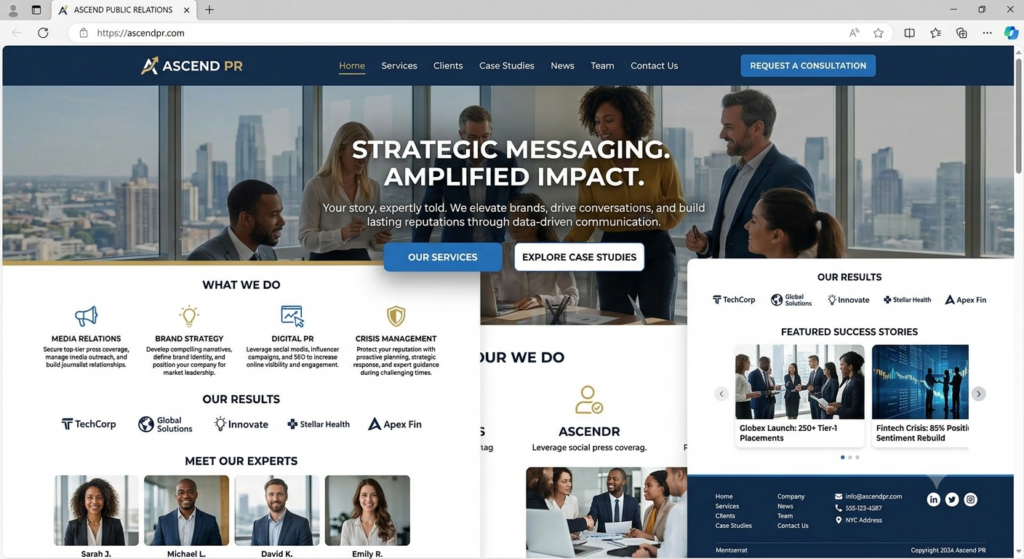
Two candidates apply for the same PR role. Same years of experience, same job titles, nearly identical CVs. One sends a link to a site with four case studies — goal, strategy, coverage, numbers. The other sends a PDF of their resume.
You already know who gets the call.
Same story on the client side. When a company shortlists agencies or freelancers, the proposals tend to read alike. Everyone promises media relations, strategic counsel, and measurable results. A PR portfolio is the thing that turns those promises into evidence.
This guide covers what a PR portfolio actually looks like, what belongs in it, how to build one from scratch, and the mistakes that quietly sink otherwise strong candidates.
What Is a PR Portfolio?
A PR portfolio is a curated collection of your best public relations work — writing samples, campaign case studies, media placements, and the metrics that show those campaigns did something.
The key word is curated. It’s a highlight reel, not an archive.
People often assume their CV or LinkedIn profile covers this. It doesn’t, and the difference is worth spelling out:
| CV / LinkedIn | PR Portfolio | |
|---|---|---|
| Content | Lists roles, skills, and experience | Shows actual work: press releases, campaigns, coverage, results |
| Context | Job titles and short descriptions | Explains the goal, your role, the approach, and what happened after |
| Format | Text-based profiles and summaries | A site built to present work with images, links, and case studies |
Your CV says you managed media relations for a beverage brand. Your portfolio shows the campaign, the outlets you landed, and the traffic spike that followed.
Do You Actually Need One?
It depends on your situation, but it almost always helps.
If you’re freelance or consulting, it’s essential. When a prospective client finds you online, your portfolio is the evaluation. It lets them see how you approach campaigns and what results you tend to produce, which makes the hire/don’t-hire decision much easier for them. In practice it becomes your main proof of experience — supporting your pitches, your proposals, and even cold introduction emails.
If you’re going in-house or agency-side, it’s increasingly expected. Not always required, but at competitive agencies it’s becoming the tiebreaker. When two candidates look similar on paper, the one who can show real campaign results wins. A hiring manager who reads your cover letter and then lands on a polished portfolio gets a far more complete picture than someone working from a CV alone.
If you’re junior, it matters more, not less. You have less experience to point to, so demonstrating how you think becomes the whole argument. More on that below.
Worth knowing how people actually review these: visual polish first (does this person present themselves professionally?), then strategic intent (did they understand what the campaign was trying to achieve?), then measurable impact (real numbers, not vague claims), and finally process (how do they work?). Build for that order.
What a Strong PR Portfolio Looks Like: The Three Core Sections
Strip away the design decisions and every good PR portfolio communicates three things.
1. Who You Are and What You Do
Your homepage has about ten seconds to answer one question: who is this and what do they do?
Include:
- A clear headline with your name and specialization. Don’t overthink it. Something like “PR Strategist Specializing in SaaS and Tech Brands | 8 Years of Earned Media Experience” does the job.
- A short positioning statement explaining why you’re the right person for this kind of work.
- A professional photo.
- Credibility signals — outlets you’ve appeared in, client logos, certifications.
Your About page then gives the fuller picture: professional background, industries you’ve worked across, key achievements, and just enough personal context that people feel like they know you. Keep it scannable — short paragraphs, clear hierarchy, no walls of text. This is also the natural place to link a downloadable PDF resume for anyone who wants the formal version.
2. Your Work, Told as Case Studies
This is where the portfolio earns its keep, and it’s where most people go wrong. The critical shift is from responsibilities to results.
Anyone can write “managed media relations” or “developed press release strategy.” Neither tells a hiring manager whether your work made any difference.
Every project should answer three questions: What was the goal? What did you do? What happened?
A strong PR case study includes:
- Campaign goal and strategy — what was the client trying to achieve, and what was the PR angle?
- Execution and channels — what you actually did, which outlets you pitched, what content you created.
- Your specific role — did you lead strategy, write the releases, run media relations, or all three? Be honest here; agency work is collaborative and pretending otherwise is easy to catch.
- Media coverage and placements — where the story ran, with live links wherever possible. Placements in credible outlets carry real weight.
- Results and metrics — media pickup count, traffic increases, social engagement, share of voice, whatever KPI proves the campaign worked.
Dedicated case study pages beat PDFs and loose links for three reasons: they’re easier to browse, easier to update, and they give you full control over how the work is presented.
Format each case study for scanning. A clear headline, a short intro paragraph, then subheads for goal, approach, execution, and results. Pull key stats out as callouts so a skimmer catches them. Add screenshots of coverage, campaign assets, or placements to make it visual.
3. An Obvious Way to Contact You
Put your email or contact link in the header or footer so it appears on every single page. Options include a dedicated contact page, a short contact form, or simply a visible email address — and a direct email often reassures clients more than a form alone, because it feels more human.
Close with a plain call to action: “Looking for a PR professional for your next campaign? Let’s talk.” — with a button that actually goes somewhere.
How to Create a PR Portfolio: 7 Steps
Step 1: Define Your Positioning and Niche
What kind of PR do you do, and who do you do it for? Get specific. “PR professional” tells nobody anything. “Consumer PR for food and beverage startups” tells them everything.
Step 2: Select Your Strongest Campaigns
Pick three to six projects. That range is deliberate — enough to show range, few enough that someone can review your best work in 10 to 15 minutes.
Choose projects that tell different stories: a crisis you managed, a product launch, a media relations grind that paid off. Range beats volume.
Step 3: Turn Each Campaign Into a Case Study
Use the structure above. Write the results first, then work backward to explain the approach — it forces you to lead with what matters.
Step 4: Choose Your Format
A portfolio website is almost always the right call. It’s easy to share, looks professional, updates in minutes, and works on any device. Wix, Squarespace, and Copyfolio are solid options; Carrd or Notion work fine for something faster and simpler.
PDFs can supplement a site, but shouldn’t replace one. They go stale, can’t be tracked, and make a weaker first impression.
Step 5: Keep the Design Simple and Consistent
You don’t need design skills. You need consistency: one or two colors, one or two fonts, applied throughout. Most platforms have global style settings that let you set this once.
This matters more than it sounds — a Stanford study found 75% of visitors judge a company’s credibility based on its design. But “good design” here means clean and readable, not elaborate. Match the tone to your work: corporate communications calls for restraint, entertainment and lifestyle PR can carry bolder branding.
Common design failures: too many fonts, low-contrast text, excessive animation, cluttered layouts.
Step 6: Get a Custom Domain
yourname.com or yournamePR.com adds instant credibility and is far easier to share. A default subdomain like yourname.wixsite.com works in a pinch, but it signals that the portfolio was rushed.
Step 7: Optimize, Review, and Publish
Structure the navigation simply: Home → About → Work → Contact.
Before publishing, handle the basics that most people skip:
- Descriptive page titles and meta descriptions, with your target keywords used naturally in headings
- Alt text on every image, and descriptive file names (
media-placement-forbes.jpg, notIMG_1234.jpg) - Mobile display checked on an actual phone
- No broken links, no typos
If you want the site to pull in inbound interest rather than just serve as a link you send, publish regularly — campaign insights, PR trends, notes on what’s working. Fresh content signals to search engines that the site is active.
Adding Testimonials and Social Proof
Testimonials build trust faster than anything you can write about yourself.
Ask past clients for a few sentences focused on outcomes, professionalism, and the specific value you delivered — a concrete detail (“she got us into three trade publications in six weeks”) lands harder than general praise.
Place them strategically: on the homepage, between case studies, or on a dedicated page. Pair them with client logos where you’re permitted to use them.
Don’t have any yet? Ask. A short, direct email requesting feedback usually produces something usable, and even two sentences from a satisfied client changes how the rest of the page reads.
6 PR Portfolio Mistakes That Cost People Work
1. Listing responsibilities instead of results. “Managed media outreach” describes a task. “Secured 18 placements across national business and tech outlets in Q3, contributing to a 22% increase in website traffic” describes impact. Always answer: what changed because of your work?
2. Padding it with weak projects. Five strong case studies beat fifteen average ones. If a project doesn’t show your best thinking, execution, or results, cut it.
3. Having no clear positioning. If someone can’t tell within ten seconds what kind of PR you do and who you do it for, rewrite the homepage.
4. Skipping metrics. Numbers make claims believable. And if you don’t have hard numbers, use concrete success indicators instead — “resulted in a full-page feature in an industry trade publication” is real evidence. “Campaign went well” is not.
5. Burying your contact info. If someone likes your work, they should reach you in one click.
6. Overdesigning and under-explaining. A beautiful portfolio with vague descriptions is worse than a plain one with well-told stories. Design should support the work, not obscure it.
Two Situations Worth Addressing
“I’m junior and have no big campaigns”
Include what you have: internships, student projects, smaller clients, personal projects, or simulated case studies where you pick a real brand and build out the campaign you’d run.
Hiring managers reviewing junior candidates care more about how you think than the size of the logos. A well-reasoned spec campaign for a brand you admire tells them more than a vague line about assisting on a major account.
“Most of my work is under NDA”
You can still use it — carefully. Anonymize the client (“a B2B SaaS company in fintech”), strip sensitive details, and focus on strategy, process, and results. Never share internal documents or private data. Check your agreement before publishing anything, and when in doubt, ask.
Your PR Portfolio Checklist
Before you publish:
- ✅ Clear headline and positioning on the homepage
- ✅ Professional photo and a strong About page
- ✅ 3 to 6 case studies showing strategy, execution, and results
- ✅ Metrics or concrete outcomes in each case study
- ✅ Media coverage examples and placements visible
- ✅ Testimonials with client logos where possible
- ✅ Contact info on every page plus a clear CTA
- ✅ Custom domain connected
- ✅ Mobile-friendly and fast-loading
- ✅ No broken links or typos
Then revisit it every three to six months, or whenever you finish a campaign worth showing. An outdated portfolio actively hurts you if your best recent work isn’t on it.
Publish It Before It’s Perfect
A PR portfolio doesn’t need to be flawless on day one. It needs to exist, be clear, and show real work.
The people who stand out aren’t the ones with the prettiest websites. They’re the ones who can explain exactly what they did, why they did it, and what it achieved. That’s what hiring managers remember and what clients trust.
So if you’ve been waiting for more work, better design skills, or a free weekend — stop. Start with three solid case studies, a clean homepage, and a contact page. Publish. Then improve it.
Treated properly, a PR portfolio is a 24/7 pitch: link it in your email signature, send it with proposals, share it when you’re introducing yourself. The more visible it is, the more it works for you.
Frequently Asked Questions
How long should a PR portfolio be? Shorter is usually better. Most strong portfolios have three to six detailed case studies plus a few supporting samples. Aim for something reviewable in 10 to 15 minutes, not an exhaustive record of everything you’ve ever touched.
What’s the difference between a PR portfolio and a CV? A CV lists roles and skills. A portfolio shows the work itself — campaigns, coverage, and results — with the context to explain what you were trying to achieve and whether it worked.
Can I include NDA or confidential work? Yes, with care. Anonymize the client, remove sensitive details, and focus on strategy and outcomes. Check your agreement first.
Should I tailor my portfolio for different roles or clients? Keep one main portfolio and adjust which projects you lead with. Pitching a tech startup? Front-load your SaaS work. Applying to an agency? Highlight multi-channel, high-pressure campaigns.
How often should I update it? Every three to six months, or whenever you complete a campaign worth showing. Regular updates also keep the site fresh for search and signal that you’re active.
Do I need a custom domain? It’s worth the small cost. A custom domain looks professional and is easier to remember; a default platform subdomain reads as unfinished.
Leave a Reply